• We are a multilingual website again. Read the notice about this.
  • Understand AI use at MyPTSD: all AI use is explained in our AI help page. AI use is by choice here. It exists if you want it, but does nothing unless you choose to use it.

How Do You Monitor Sleep?

Status
Not open for further replies.

app

New Here
How do you keep track of your sleeping? I've been using Sleepbot, a free Android app on my phone. There is also something called a Fitbit you can wear to track how much you're walking, as well as sleep. What, if anything, do you do?
 
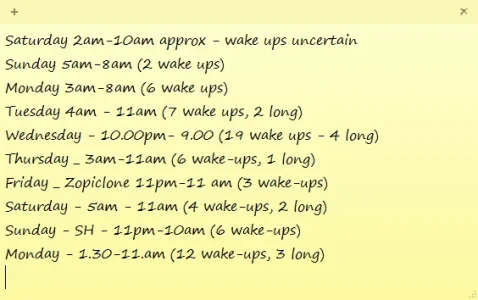
Often I don't, but right now in a sticky note on my desktop. I record the number of times I wake up for less than 10 minutes, and the number of times I wake up more than half an hour and if I took Zopiclone to help me sleep, I haven't recorded Lorazepam on it because I haven't used it to aid sleep, if I've taken it, it's been more than ten hours prior to sleeping. I also marked a relapse in self harm, because my sleep was much better after it.

I update it first thing when I wake up as I hate to get up suddenly, I go to my computer to ease my self awake and then when I feel ready I go downstairs to get breakfast, the time it takes me to do this is vastly dependant on how well I feel able to deal with other people. Out of curiousity though, how does it track your sleep? I tend not to use screens during the night as it worsens sleeping, so if not manual, do you wear it or does it pick up on the sounds you make or something?
 

Attachments

  • sleep.webp
    sleep.webp
    31.8 KB · Views: 195
Last edited:
@Bedbug, you might be right about that. I'd rather use a fitbit.

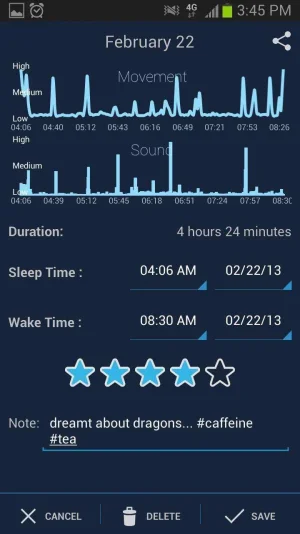
@Kas_Can_Fly you put the phone by your pillow and it uses the accelerometer to record movement, and also records sound. You can see graphs of movement, sounds, your sleeping trends, sleep patterns, and such. You just hit go to sleep and it puts your phone to sleep and starts recording after 10, 15, 20, or whatever you want it to. And export some stuff to a spreadsheet. I keep having to reset it, so Bedbug might be right.

I think with a fitbit, you don't have to worry about that and just wear it, but I'm not sure.

I might start trying to record your way for a while, thanks. :)
 
That does sound interesting but how does it know you aren't snoring/sleep talking and moving in your sleep? I move a lot in my sleep, I know because my covers get so twisted and several other things too.

I don't monitor it to get better at sleeping, but merely just keeping tabs on what I remember. Right now I'm keeping an eye on it because it's not been great since coming out of hospital. I'm not good at working things out about myself, so something like this is easy enough to keep an eye on. Right now if I'm more irritable it's likely because without the wake-ups, I'm still getting to sleep way too late. If it persists I will try different methods to go to sleep earlier. The wake-ups are not something I can change, but I can let other people know (like my T, GP or other professionals) - apparently it's not normal to wake up during the night at all and this lets them know roughly what kind of sleep issues I have.
 
You have to tap the screen to tell it when you're going to sleep or waking up. That's where it can get annoying. Here's what one screenshot of it looks like. You can actually click on the sound graph and hear the sound at whatever time. For some reason it doesn't always record sound for me.
 

Attachments

  • sleepbot.webp
    sleepbot.webp
    67 KB · Views: 185
Thanks for explaining! I think I'll just stick to a rough count of what I remember in the morning! So I may wake up a few extra times than I record, if I don't remember it, it can't have been that big a deal and I don't have to do anything for that :)
 
Thanks for explaining! I think I'll just stick to a rough count of what I remember in the morning! So I may wake up a few extra times than I record, if I don't remember it, it can't have been that big a deal and I don't have to do anything for that :)

Yup, there is also this coming out soon to make it easier.

The National Institutes of Health says that 50 to 70 million Americans are affected by chronic sleep disorders and intermittent sleep problems that can significantly diminish their health, alertness and safety. Withings, a manufacturer of personal health gadgets such as blood pressure monitors and wearable fitness trackers, came out with a new sleep-improvement technology called the Aura that’s creating a lot of buzz at this week’s CES trade show. It’s a highly sensitive pad that slips unobstrusively under your mattress and measures macro- and micro-movements of your body through the thickness of a standard-sized mattress. The sensor pad is sensitive enough to detect minute movements such as the rise and fall of your chest when breathing or, when you’re laying completely still in deep sleep, can even detect your heart rate. It factors in these movements to measure your sleep rhythms as they progress from a waking state to deeper REM sleep and back up again to lighter sleep.

The Aura pairs with an iPhone app that visualizes all your sleep data in a user-friendly graphic format, and combines with a bedside lamp and alarm clock that brightens to guide you to a restful waking state at the right time. The bedside lamp also captures ambient noise and temperature to let you know later what the conditions are when you were woken, in case you need to tell your neighbors to pipe, down or turn the thermostat up before you wake the next time. At $299 it isn’t cheap, but Withings says that its users can achieve noticeably better sleep within days or weeks of use.

Then again it's $300, so yeah, sometimes simpler is better. :)
 
I've had trouble sleeping for quite a while now. Some nights I only get 3 hours and if I get more, it is always broken. Two to three am is always my problem time.

I recently purchased the UP24 by Jawbone. I was using an iPhone app where you were supposed to tuck your phone under your fitted sheet etc...but it had all sorts of issues.

I thought the UP24 would give me great insight as to the daytime trigger tracking that would lead to a sleepless night. It does that (food, drink, mood tracking). However, I've found it simply more comforting just to find that I sleep a little better than I thought. Those long stretches between 2 am and 6 am where I thought I wasn't sleeping at all, actually weren't as bad as I thought. This made me feel a little better about my day.

Normally, I would wake up panicked thinking it was going to be a horrible day because I 'didn't sleep', when I actually did.
 
Last edited by a moderator:
I use Fitbit. I don't always turn it on at night but I'm always weak it anyway to count my steps since it helps with my physical issues (my PTSD is from a car crash so I deal with physical issues from that also). If we play with my meds or I start feeling more out of sorts than usual sometimes it helps to see the sleep issues. Plus, the docs like seeing it when I'm having issues.
 
Status
Not open for further replies.

Donation drives

2026 Donation Goal

Goal
$1,800.00
Earned
$910.00
This donation drive ends in
0 hours, 0 minutes, 0 seconds
  50.6%

Trending content

Featured content

Back
Top Bottom