• We are a multilingual website again. Read the notice about this.
  • Understand AI use at MyPTSD: all AI use is explained in our AI help page. AI use is by choice here. It exists if you want it, but does nothing unless you choose to use it.

PTSD - If You Could Draw It Or Describe It - What Would It Look Like

Status
Not open for further replies.
Kaydee: Very interesting image you portrayed. My first reaction to this question was thinking that it would be like a Hurricane. Which you described exactly pretty much.

There are the high winds and moisture as you cross the storm and then there is the eye for the periods of calm. The duration is longer than a tornado.

Then I got thinking am I always in the eye or on the outside of the storm to tough it out as it veers my way again. OUTSIDE. Another piece of the storm that I see are pieces of mirror flashing up through the wall of winds. Fragments of my life being swept away by the winds.

Very cool question. I'm going to think on this.

Cindy
 
I imagine my PTSD as a broken, slimy, raw egg that trying to hold onto it.

Ever tried to hold onto a slimy, raw egg in your hand? It just oozes everywhere.

That's how I feel like "myself" is------uncontrollably slipping away in every direction, between your fingers as you grab it in your fists and no way to hold on to it.
 
Sketches of PTSD problem solving w/Graphic Representation

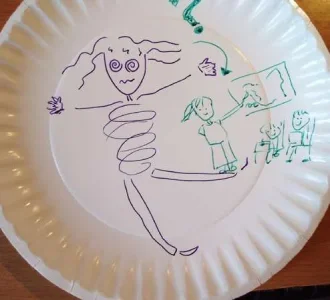
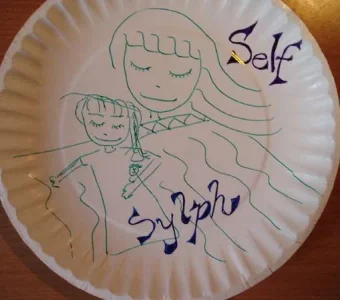
I'm a teacher and while working on my professional portfolio have been interrupted by PTSD triggered when asked to participate as a 3rd party witness in a criminal legal case. All of a sudden I can't concentrate on writing 15 page analyses(sp?) of the contextual factors of learning, etc. I have attached two sketches made by myself during a problem solving activity originally developed to help impulsive, verbally imature children in understanding and expressing the feelings associated with a conflict they are involved in. After a brief description of how PTSD is involved in the sketch, I'll post the shorthand steps for the process for those interested...

The problem is that I don't know how my past trauma fits in my current life.

1st sketch shows my picture depicting the problem: in short- I feel disconnected from who I was as a teacher- The purple figure is me: my hands and feet are flying off- my core is a turmoil- my eyes cannot focus- my lips are in a queasy dispair- not sad, or frightened, or mad- a mix of something unknown. The green picture is what I have done and am supposed to be writing about- teaching gerography to elementary students.

2nd sketch shows the way I will feel when the problem is resolved: I will feel at rest, comforted and comforting my own child, who is comforted by and comforting her doll. The words self & sylph are displayed graphically, denoting that I will feel my soul is mine and is as light as a cloud. A sylph is a lesser known mythological element of the air- a face in the cloud.

In this process, which is completed quickly without self-censoring, the following steps are used.

1. Identify your most pressing issue and write it concisely in one sentence.
2. Draw a picture of the problem.
3. Write your feelings about the problem that come immediately to mind.
4. Draw a picture of how you will feel when the problem is resolved.
5. Write the first five possible solutions to the problem that come to mind, regardless of realistic achievability.

This exercise can be completed using paper plates, with a drawing on the front and the following writing step on the back. It can be used in a group with the speaker holding the plate in front of their face and reading what is on the back to reduce affective anxiety about claiming a feeling or fearing someone else's reaction to your open thoughts. It's best if there are no words in the drawings.
 

Attachments

  • P1010011.webp
    P1010011.webp
    24.3 KB · Views: 210
  • P1010012.webp
    P1010012.webp
    25.2 KB · Views: 203
Great contribution dharmaBum thank you....have some reputation from me.

Good topic Kaydee....something different. Again, have some reputation from me.
 
For me, the first thing that popped into my head when trying to visualize PTSD is a very small, young, healthy tree that has been pulled out of its soil, and some kid is holding the tree in his hands, and I'm the roots that are trying so desperately to reach for the ground so I can grow.
 
Hi Dharmabum

Thank you for insight, I will try your exercise.

The interesting thing for me is that, it wasn't until I tried to visualize PTSD that I started to really see it and its changeability (probably not a good word to use).

What you have suggested (to me) breaks the magnitude of the image down and focuses on a particular element - visualization is one thing, learning how to use it for a positive outcome - fantastic.
 
I am a artist too, in quilts, and I also see my PTSD like those three photos, but a little out of focus. It's like you are seeing the first photo, the bright one, which is my photo of anxiety in all it's screaming glory, but the photo is out of focus so the the sharp lines are not distinguishable. I think that people who don't have PTSD can't "see" what I see, and they don't understand my life. They think they can interpret what that is (me) they can guess at it, but they truly don't understand. My art is like that. I have to explain what it means to others.
 
thx 4 the topic & reply kaydee & nicolette.

I've found in my work with children that sometimes the prompt to put their thoughts and feelings into words- verbal or written- panics them into seemingly greater depths of fear than that which they experience when facing the original problem. Sometimes children are much more verbose when given the freedom to use graphic representation to depict their ideas and then listened to when explaining or describing what is going on in the picture.

As evidenced by previous posters on this thread, images have their compositional meaning- logographic cultural history- but the use of an image means so much more within the context of an event/feeling and the creator. It goes a step further if the creator wishes to use the image for communication as well as expression, and communication with whom...

People/survivors/victims/self(ves) can be substituted fairly appropriately for children/creator in the previous statement.
 
What does your PTSD sound like?

This post reminded me of an audio file I compiled last year when I was having trouble concentrating on writing a paper. I was not consciously aware of my PTSD issues at that time- just thought there were several aspects of my thinking that I couldn't get a handle on.

The lyric or text of the file is based on a writing experience I attempted in order to change the dynamic of my inner dialogue. Because I did not think that typing a linear journal entry would help me clear my mind, I attempted to use my voice to write my thoughts by dictating to Microsoft Word. However, I didn't want to get caught up in editing or correcting the dictation while I talked, so I just spoke the stream of consciousness and then checked it out to revise. In many cases, what Word had interpreted was bizarre, but poetically interesting. I revisited Word's transcript using the William Burrough's style cut-up technique by looking at the transcribed words in their own rite and arranging them as a new message. Then I read the new words aloud and recorded it as an audio file. I used the free program Audacity to manipulate tracks and mix the recording as a work of audio art, adding another track of vocalization that was a commentary on the Word generated cut-up. This file is designed to be listened to using headphones at the highest volume that doesn't produce distortion.

The resulting audio file is a layered piece where some thoughts and phrases are voiced at different speeds with elements of delay and echo. For me, it gives the impression of different themes of memory and idea being repeated by different aspects of a person's character- being repeated concurrently to them directly in their ears/mind. Some parts make sense, some seem unrelated, some echo into a beat that becomes an entirely new noise. A slow-ish aural vocalization- the thread of continuity- seems to represent my conscious self which attempts an integration of the ideas and also to generate a sense of calm.

The primary repeated concept in the piece is about "someone coming home". At the time of recording, I was distractingly hypervigilliant. I live in an old house in the country on the end of a dead end road. I had had major issues with meth-addict neighbors and two separate car-stripping/theiving rings one and two years before. I was writing in my bedroom, with no ability to see street traffic (which there should have been none), but continually felt like I heard cars driving up to my house. Interestingly, in retrospect, I recently read a recovery journal of mine written shortly after disclosing four years of rape and sexual exploitation as a child. One of the more distressingly emphasized points was about how there were frequently people in the house upstairs, in the bedroom next door, or literally knocking at the bedroom door while I was being raped. I think that that trauma was probably the biggest influence on this repetive thought.

At the time of recording, I was also stressed that my husband would come home while I was in the throws of unproductivity, "talking to myself" about crazy thoughts- and I wouldn't hear him, or he would be disappointed in my use of what should have been study time.

I'd like to post the file here for people to listen to at their own risk, but I get a database error when I try to attach it a .zip
 
I drew a supposedly funny cartoon of a cat that lept up to the ceiling, hanging upside down, claws dug into the plaster (or whatever material), with hair sticking straight out, tail at attention, cat eyes bulged and teeth gritted. Then that poor cat clunks down to the floor and scrambles under a wing chair and shakes like a dog does during a thunderstorm.

Yeah. PTSD is like that. It's also a zap of lightning, rain--no, hail--pounding, pounding, raindrops slamming themselves against windows, and then fallen debris roughed about in puddles.

pianogirl
 
I did a fair bit of painting after my car crash. Most of it is an attempt to capture the on rushing trees as the car spun through the air. In my mind the image is replayable.
 
I was into oil painting when I was first diagnosed with PTSD, I visualised it as a huge fire but with dark almost black smoke billowing out and twisting in all directions with lots of eyes in the smoke watching.
 
Status
Not open for further replies.

Donation drives

2026 Donation Goal

Goal
$1,800.00
Earned
$910.00
This donation drive ends in
0 hours, 0 minutes, 0 seconds
  50.6%

Trending content

Featured content

Back
Top Bottom