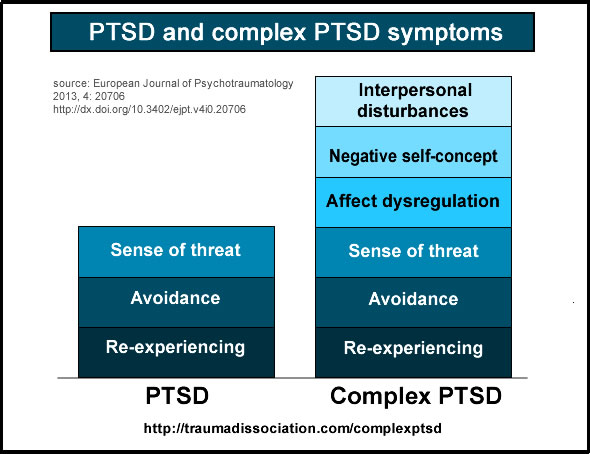
That is because you have the complex version of PTSD. You wouldn't have them both. If you break your leg in two places you don't have a fracture and a compound fracture, you just have a compound fracture. They are 2 different diagnoses, but you have to satisfy the criteria for a fracture to have a compound fracture.
"The criteria for CPTSD are the same as those for PTSD, but with the addition of disturbances in self-organization". from:
ICD-10 versus ICD-11: the effects of PTSD diagnoses - ACAMH
The ICD-11 formulation of PTSD requires exposure to a trauma defined as an extremely threatening or horrific event or series of events. Similar to the original DSM version of PTSD, the disorder includes three core elements or clusters: re-experiencing of the traumatic event in the present, avoidance of traumatic reminders and a sense of current threat. This formulation conceptualises PTSD primarily as a conditioned fear response and the re-experiencing and avoidance symptoms are specifically tied to the traumatic event. CPTSD includes the three core elements of PTSD as well as three additional elements called disturbances in self-organisation that are pervasive and occur across various contexts: emotion regulation difficulties (for example problems calming down), negative self-concept (for example beliefs about self as worthless or a failure) and relationship difficulties (for example avoidance of relationships)
This is from:
ICD-11 complex post-traumatic stress disorder: simplifying diagnosis in trauma populations - Volume 216 Issue 3

www.cambridge.org
Complex post traumatic stress disorder (Complex PTSD) is a disorder that may develop following exposure to an event or series of events of an extremely threatening or horrific nature, most commonly prolonged or repetitive events from which escape is difficult or impossible (e.g. torture, slavery, genocide campaigns, prolonged domestic violence, repeated childhood sexual or physical abuse). All diagnostic requirements for PTSD are met. In addition, Complex PTSD is characterised by severe and persistent 1) problems in affect regulation; 2) beliefs about oneself as diminished, defeated or worthless, accompanied by feelings of shame, guilt or failure related to the traumatic event; and 3) difficulties in sustaining relationships and in feeling close to others. These symptoms cause significant impairment in personal, family, social, educational, occupational or other important areas of functioning.
ICD-11 MMS code 6B41 Complex post traumatic stress disorder with excludes, code elsewhere, and included sections/codes.

www.findacode.com
I hope that clears up what I was saying. I quoted so many sources because I wanted to make sure I read it right.