• We are a multilingual website again. Read the notice about this.
  • Understand AI use at MyPTSD: all AI use is explained in our AI help page. AI use is by choice here. It exists if you want it, but does nothing unless you choose to use it.

Requesting physical touch (hand on shoulder while crying) in therapy?

Status
Not open for further replies.

Ecdysis

Diamond Member
I am seeing a trauma therapist and I want to request physical touch (him putting his hand on my shoulder) when I cry, to help process very early childhood trauma.

I find that this pre-verbal trauma (ages 0 - 3) is not accesible in normal talk therapy and I would like to try accessing this trauma material by just me silently crying, and him placing his hand on my shoulder in a soothing, comforting gesture.

I'm unsure whether he even offers this.

I feel weird asking.

I'm not sure how best to approach it.

I'm very "professional" about therapy... Never cross any boundaries, never get "emotionally over-attached" to therapists, I'm very matter-of-fact, always stick to appointment times and other agreements...

So this doesn't feel inappropriate/ weird from my side.

I just have no idea whether he's done that kind of work in the past or would even be open to considering it.

Also, if I ask and he's visibly uncomfortable, it may feel weird to me...

I'm thinking of asking him at the end of a session and specifically saying "I do not want an answer today. Please take this question with you and think about it the next couple of weeks and talk to your supervisor or whoever about it to work out whether this could be workable for you and then give me an answer next time, with a good explanation either way."

I'm considering offering for him to video tape the therapy sessions in case he's worried that any physical touch in therapy (especially in trauma therapy) could be risky for him in a professional setting - for example, in case I theoretically at some point would say that it was inappropriate. If it would give him a layer of safety to be able to present videos of all of the sessions to prove that it was just the agreed hand-on-shoulder-while-crying, then that would be okay for me.

Also, I'd be willing to sign a consent form specifying the exact agreed upon modalities and that it was a request by me to process pre-verbal trauma.

Any advice?

I'm not worried at all that it will be triggering for me - if it were, I wouldn't be considering asking about this.
 
Last edited:
That all sounds good to me, in fact I think it is a great idea. I am going to consider this in my own journey as I was deprived of affection starting when I was pre verbal. As best I can tell, there never was any affection.
 
I think it is difficult, but it is definitely worth it to talk with him about it to explore it, because it is such a strong and meaningful feeling for you, even without knowing if he would do it.
I am not against or for it, that is your and the therapists decision. Maybe it takes out some pressure for you if you talk about that feeling first before directly asking him.
 
I think it’s perfectly reasonable to ask.
I'm thinking of asking him at the end of a session and specifically saying "I do not want an answer today. Please take this question with you and think about it the next couple of weeks and talk to your supervisor or whoever about it to work out whether this could be workable for you and then give me an answer next week, with a good explanation either way."
This is a very respectful and communicative way to put the idea out. You clearly prioritise the consent/comfort of both parties in it, which is important both ways in therapy.


I think it’s always worth asking. This is your trauma and processing, if you know it will help, at least having an open discussion about it with T feels like it will be productive.
I’ve been thinking about showing my T, in future, some very heavy documents. I want to ask her first so it can be done in a way that’s safe for both of us, and make clear what I need/want from it. (I just want someone to see the suffering with me, so it’s not trapped, isolated to me, and can cry about it, maybe).
 
TOTALLY an okay thing to ask… but also be prepared for them to EITHER say no -or- say yes, do so, and have it go badly.

Meaning there will PROBABLY be a conversation involved, that will eat time, if this is important to you.

I’ve had therapists who were willing to SPAR with me, during session. And therapists who refused to come any closer than one arm’s distance. Regardless of what their answer is to a simple hand clasp? That’s ENTIRELY about them, and their comfort level. Absolutely zip zero nada zilch about you, what you need/want, what you deserve, what works best for you, what’s right/wrong generally speaking, etc..
 
Thank you for your thoughts @all ! 🙂 👍

or- say yes, do so, and have it go badly.
Yeah... that's an option I've got in mind too... If I raise this with him, I'm going to point out that if he does it but it's not out of conviction... then it will feel weird and not-soothing and not-comforting...

I've googled to see if anyone locally offers any kind of somatic work... There's one therapist that might fit and I emailed her to ask...

Also, I've done occupational therapy in the past and they're often more flexible about things like touch, so I might ask there too...
 
Also, I've done occupational therapy in the past and they're often more flexible about things like touch, so I might ask there too...
Cha. It’s kind of amaaaazing the difference standards in different specialities. Like physical therapists? Are -almost universally, but with some serious exceptions- reeeeeeeeally hands on.

Trauma therapists, touching vs not? Coin in the air, whether it’s easy as, under certain conditions only, or absolutely not. But that’s all about THEM. Which is usually a hard-hard-hard thing for clients (because everything is always our fault??? Or maybe something else, like avoidance, or whatever. Regardless. We trauma peeps tend to take shit personally).
 
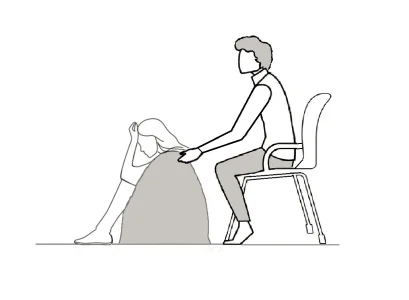
I've made a drawing of it... to try and process the idea emotionally...

Not sure, what I think and feel about it...

There's probably a better way to represent it visually, but my creative visual/ drawing skills are limited...

I'm wrapped in a blanket, to provide the bulk of the soothing and comfort...

I want to sit on the floor, to better access very young parts... Sitting upright in a chair feels too "grown up" for this kind of earliest-childhood trauma work...

drawing2.webp

(It's my own image creation, as regards copyright)
 
Is facing away necessary to you? Or would side-on or facing to T be an option? Forgive the kind of curious question. I ask it also for your logistics in asking it to T.

The idea of T and touch in the same realm (while has crossed my mind some times) is very new to me. For me, therapy is done sat on the floor, opposite eachother (I don’t like the idea of sitting in a seat, we’ve never sat on the sofa/armchair, despite it also being opposite, and a bit more distanced) we’re 3ft? away from each-other, the closest she gets to ever touching me is if we play catch, and when we’re vaguely in the same place coming in and leaving.

Sometimes, I get the thought of being sat next to her… extremely doubtful I’d do it, or even be comfortable with it at all. But it would be easier to show her certain things (if I’m writing or drawing, or using diagram). I also wonder if our child part would want something physically comforting. Much to think about.


It’s interesting seeing your perspective, as someone who is very reserved when it comes to touch.
 
Okay, I think I'm going to start by just saying this:

this pre-verbal trauma (ages 0 - 3) is not accesible in normal talk therapy

And then listen to all the suggestions he makes.

And then go from there.

And then throw in my suggestion of comforting-hand-on-shoulder.

I think that's the most sensible and organic approach.
 
Status
Not open for further replies.

Donation drives

2026 Donation Goal

Goal
$1,800.00
Earned
$910.00
This donation drive ends in
0 hours, 0 minutes, 0 seconds
  50.6%

Trending content

Featured content

Back
Top Bottom