
- Admin
- #1

anthony
Founder
To help you understand, much research towards mental health today resolves around what is simply, symptom networking. In other words, instead of having a categorical diagnosis sitting in front of you and then fitting a person within that diagnosis for the sake of labelling, a network approach looks at the cause and thus symptoms, what symptoms are suffered the worst to least, then examined as to what symptoms are reinforcing / creating other symptoms versus the symptom being self-sustaining / standalone.
Think about it like this -- does this symptom really exist, or is it merely existing because this other symptom is creating and reinforcing its presence?
Simple example: You can't get to sleep because your brain is thinking about all these other things. This causes insomnia, which then makes you fatigued, and thus you can't concentrate on what you're doing, thus you lose your temper easily.
Are you depressed? That is what you would be diagnosed with based on those symptoms from a categorical view. The answer is no, you are ruminating, being the cause to target and treat the problem. When you're no longer ruminating you are no longer fatigued, thus concentration is good and as such, you aren't losing your temper so readily. Treat the cause, all the other symptoms disappear.
The current system is categorical, hence it is full of holes that experts are trying to understand why. Especially treating these symptoms with medications, when realistically, many symptoms are created by other symptoms, thus medication is not treating anything. They have this early understanding from the network model... yet categorical diagnosis is big business, so until they revamp big business to the more accurate network model, we won't see that any time soon. More research is still needed into the networking approach. Or someone like Google comes in and open sources mental health diagnosis online.
You hear this all the time from experts (your therapists) when they tell you not to worry about labels. They're likely aware of the network model and its qualitative results from studies, treating you based on cause and effect, being the commonsense approach.
So... how would we network PTSD? Think about this individually, as you can add symptoms specific to yourself, additional to what may be within the current categorical structure, yet are dismissed / not really viewed upon much, OR WORSE, are used in combination with your other symptoms to then add more labels, as though further problems are present, yet really labels are using many of the same symptoms repetitively. Over 50% of DSM symptoms are reused amongst diagnoses (renamed too).
There are 20 current symptoms for PTSD, so you would use any combination of the following (purely an example):
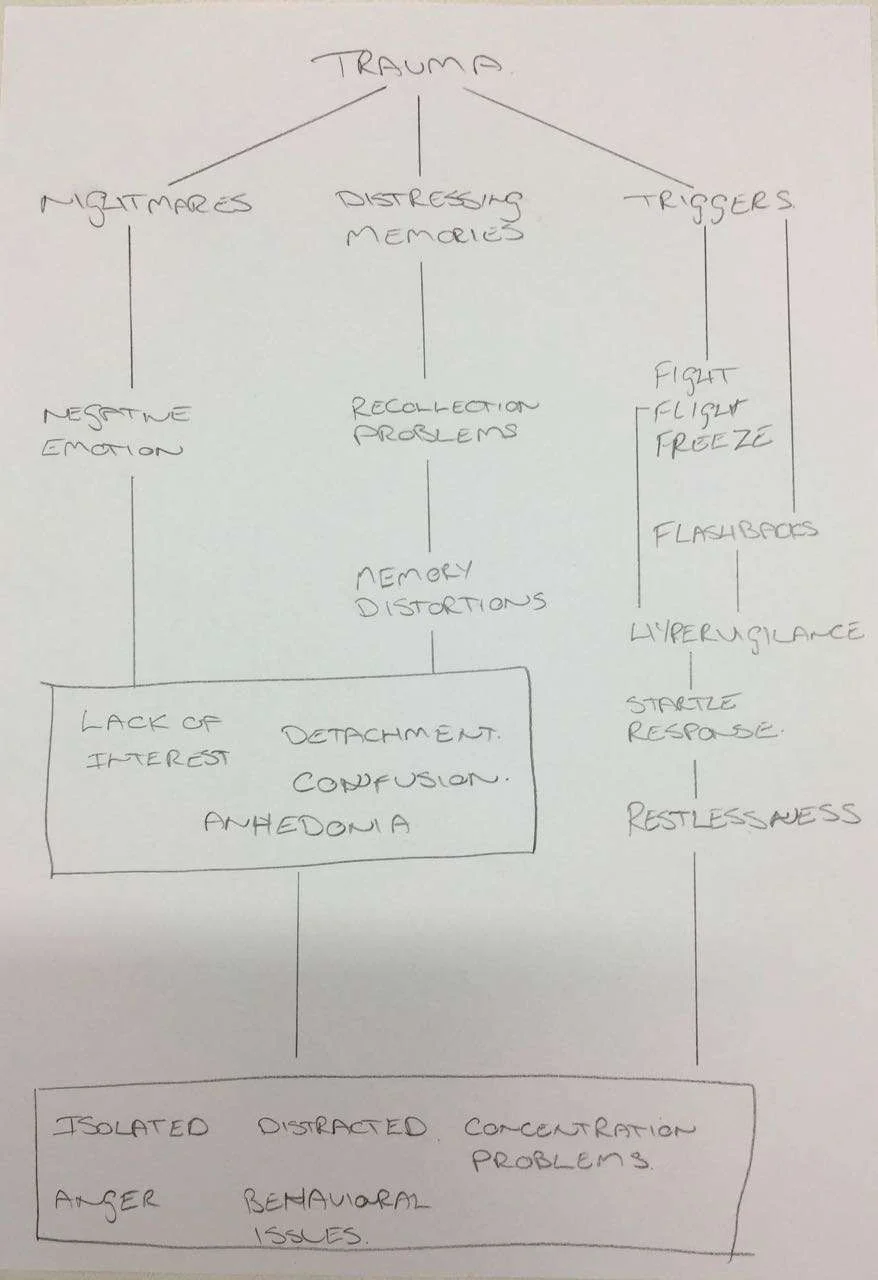
Trauma = Any combination of: distressing memories, nightmares, triggers, fight / flight / freeze, flashbacks, recollection problems, distorted memories, confusion, negative emotions, lack of interest, detachment, anhedonia, hyper vigilance, startled response, restlessness, isolation, distracted, concentration difficulties, anger, behavioural control.
You can also see some interconnected aspects above. If you viewed this like a world, where each symptom was its own bubble, some bubbles would be large and independent, some would touch, some would be small and independent or touch other bubbles, meaning they have some effect upon them.
In the above example you can see that trauma has caused three independent symptoms, the rest are a result of those three symptoms / linked or clustered in some way to those three symptoms. This makes those three symptoms your specific target.
Very few suffer all 20 symptoms as primary effect that meet debilitating levels, so obviously you would subtract and add other symptoms related to yourself, i.e. depression symptoms, dissociation and so forth, within a context where you believe they fit, then cause other symptoms, or are caused by other symptoms.
The purpose is that you find a realistic diagram of what your symptoms look like, versus just throwing labels around where you chase your tail and feel confused as to what is what and where are symptoms coming from. Instead of applying labels, the network approach ultimately identifies a logical chain reaction so you can better understand your specific symptom set.
How many times do you read people trying to fix a symptom? Then wondering why that symptom isn't going away?
If used by professionals in the future for mental health diagnosis, we may actually get more healing achieved versus labels and medication tossed around. A therapist will be able to see exactly what is independent and related directly to the cause, and what is simply perpetuated by other symptoms.
What would yours look like? Do you have improvements / suggestions to more predominant standalone symptoms as a majority?
You could draw the above using bubbles, and there proximity to other bubbles then relate to effect of one another, or independence. Size can be used to equate severity and commonality.
Think about it like this -- does this symptom really exist, or is it merely existing because this other symptom is creating and reinforcing its presence?
Simple example: You can't get to sleep because your brain is thinking about all these other things. This causes insomnia, which then makes you fatigued, and thus you can't concentrate on what you're doing, thus you lose your temper easily.
Are you depressed? That is what you would be diagnosed with based on those symptoms from a categorical view. The answer is no, you are ruminating, being the cause to target and treat the problem. When you're no longer ruminating you are no longer fatigued, thus concentration is good and as such, you aren't losing your temper so readily. Treat the cause, all the other symptoms disappear.
The current system is categorical, hence it is full of holes that experts are trying to understand why. Especially treating these symptoms with medications, when realistically, many symptoms are created by other symptoms, thus medication is not treating anything. They have this early understanding from the network model... yet categorical diagnosis is big business, so until they revamp big business to the more accurate network model, we won't see that any time soon. More research is still needed into the networking approach. Or someone like Google comes in and open sources mental health diagnosis online.
You hear this all the time from experts (your therapists) when they tell you not to worry about labels. They're likely aware of the network model and its qualitative results from studies, treating you based on cause and effect, being the commonsense approach.
So... how would we network PTSD? Think about this individually, as you can add symptoms specific to yourself, additional to what may be within the current categorical structure, yet are dismissed / not really viewed upon much, OR WORSE, are used in combination with your other symptoms to then add more labels, as though further problems are present, yet really labels are using many of the same symptoms repetitively. Over 50% of DSM symptoms are reused amongst diagnoses (renamed too).
There are 20 current symptoms for PTSD, so you would use any combination of the following (purely an example):
Trauma = Any combination of: distressing memories, nightmares, triggers, fight / flight / freeze, flashbacks, recollection problems, distorted memories, confusion, negative emotions, lack of interest, detachment, anhedonia, hyper vigilance, startled response, restlessness, isolation, distracted, concentration difficulties, anger, behavioural control.
You can also see some interconnected aspects above. If you viewed this like a world, where each symptom was its own bubble, some bubbles would be large and independent, some would touch, some would be small and independent or touch other bubbles, meaning they have some effect upon them.
In the above example you can see that trauma has caused three independent symptoms, the rest are a result of those three symptoms / linked or clustered in some way to those three symptoms. This makes those three symptoms your specific target.
Very few suffer all 20 symptoms as primary effect that meet debilitating levels, so obviously you would subtract and add other symptoms related to yourself, i.e. depression symptoms, dissociation and so forth, within a context where you believe they fit, then cause other symptoms, or are caused by other symptoms.
The purpose is that you find a realistic diagram of what your symptoms look like, versus just throwing labels around where you chase your tail and feel confused as to what is what and where are symptoms coming from. Instead of applying labels, the network approach ultimately identifies a logical chain reaction so you can better understand your specific symptom set.
How many times do you read people trying to fix a symptom? Then wondering why that symptom isn't going away?
If used by professionals in the future for mental health diagnosis, we may actually get more healing achieved versus labels and medication tossed around. A therapist will be able to see exactly what is independent and related directly to the cause, and what is simply perpetuated by other symptoms.
What would yours look like? Do you have improvements / suggestions to more predominant standalone symptoms as a majority?
You could draw the above using bubbles, and there proximity to other bubbles then relate to effect of one another, or independence. Size can be used to equate severity and commonality.


