Hi folks,
I am an iconographer. I'd like to share a little of my work with you. It is good for me to remember the good in the world when I have to deal with so much sad trauma in my own life. Here is an icon I made for a monk in Alaska where Orthodox Christianity was first introduced to the Americas.
Iconographers start with a wooden board, sometimes with the central space carved out. We use rabbit skin or fish glue to soak fine cheesecloth and apply it to the board. Then we mix chalk and marble dust with the glue so it feels and looks like cream to make gessoe. We layer the gessoe on to the board in 10 to 15 layers. Then we sand and sand and sand until the surface is flat and even. This is like a time of creation when we use the plant kingdom to supply the wood and cloth, the animal kingdom to supply the glue, the earth to supply the stone and chalk all in the service of making a new surface on which some aspect of the Divine will become manifest.
View attachment 294
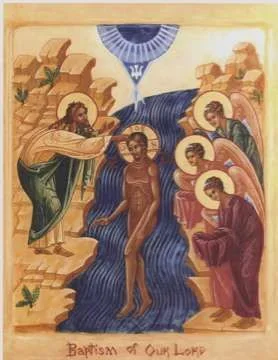
This image is a traditional Orthodox Christian image of Jesus' baptism in the Jordan River. It is one of the twelve major feasts in the church year. Jesus is being baptized by St. John the Baptist, also called St. John the Forerunner. He is the person who went ahead of Jesus on earth preaching repentance and into hell to tell hell's captives about Jesus, the one who was coming to set them all free.
Here we see three angels suggesting we remember that we believe in a triune God; God the Father, and God the Son and God the Holy Spirit, one in essence and undivided. Even the hills bow down as they recognize their creator, Jesus. There is Jesus, naked as the day he was born, in the water. St. John is hesitant to even touch Jesus's head because he feels so unworthy. Jesus reassures him that he, too, must be baptised with the water of repentance.
St. John looks up to see the dove of the Holy Spirit descending upon Jesus. A voice comes from heaven saying, "You are My Beloved Son; in You I am well pleased."
In the Orthodox way, we recognize this moment as the time when Adam's robe of glory, which he lost when he was sent out of the garden of Eden, is reclaimed by the new Adam, Jesus.
Liturgically this is commemorated by our recognizing that Jesus has rescued all creation through blessing the water with his presence. We go as whole churches in procession with the Cross and banners to bodies of water near us, large like Lake Michigan and small like a small pool in Arizona. A small cross is raised to bless the water while all people are singing and thrown into the water to be retrieved by a young boy. We do this three times. It is a joyous occasion when all creation is understood to be reconsecrated, healed, blessed by the joy and love of God.
I am an iconographer. I'd like to share a little of my work with you. It is good for me to remember the good in the world when I have to deal with so much sad trauma in my own life. Here is an icon I made for a monk in Alaska where Orthodox Christianity was first introduced to the Americas.
Iconographers start with a wooden board, sometimes with the central space carved out. We use rabbit skin or fish glue to soak fine cheesecloth and apply it to the board. Then we mix chalk and marble dust with the glue so it feels and looks like cream to make gessoe. We layer the gessoe on to the board in 10 to 15 layers. Then we sand and sand and sand until the surface is flat and even. This is like a time of creation when we use the plant kingdom to supply the wood and cloth, the animal kingdom to supply the glue, the earth to supply the stone and chalk all in the service of making a new surface on which some aspect of the Divine will become manifest.
View attachment 294
This image is a traditional Orthodox Christian image of Jesus' baptism in the Jordan River. It is one of the twelve major feasts in the church year. Jesus is being baptized by St. John the Baptist, also called St. John the Forerunner. He is the person who went ahead of Jesus on earth preaching repentance and into hell to tell hell's captives about Jesus, the one who was coming to set them all free.
Here we see three angels suggesting we remember that we believe in a triune God; God the Father, and God the Son and God the Holy Spirit, one in essence and undivided. Even the hills bow down as they recognize their creator, Jesus. There is Jesus, naked as the day he was born, in the water. St. John is hesitant to even touch Jesus's head because he feels so unworthy. Jesus reassures him that he, too, must be baptised with the water of repentance.
St. John looks up to see the dove of the Holy Spirit descending upon Jesus. A voice comes from heaven saying, "You are My Beloved Son; in You I am well pleased."
In the Orthodox way, we recognize this moment as the time when Adam's robe of glory, which he lost when he was sent out of the garden of Eden, is reclaimed by the new Adam, Jesus.
Liturgically this is commemorated by our recognizing that Jesus has rescued all creation through blessing the water with his presence. We go as whole churches in procession with the Cross and banners to bodies of water near us, large like Lake Michigan and small like a small pool in Arizona. A small cross is raised to bless the water while all people are singing and thrown into the water to be retrieved by a young boy. We do this three times. It is a joyous occasion when all creation is understood to be reconsecrated, healed, blessed by the joy and love of God.