bright_morning, the point I'm taking away is that context is everything. LSD is also being tested for PTSD. The idea is that exposing someone with an anxiety disorder to a triggering stimulus in the context of drug-induced euphoria accelerates extinction learning. They're running similar experiments on D-cycloserine in conjunction with psychotherapy for patients with anxiety disorders; except that DCS enhances memory consolidation without the benefit of euphoria.
I'm bemused by the amount of attention this is receiving from the media. The public has seized it. Every newspaper, tabloid, and online blog seems to be posting about it. This might be the Next Big Thing in psychiatry, much like the SSRIs (whose efficacy was totally out of proportion to the amount of hype they received).
I don't know many researchers who are well-funded, TBH; maybe you see that more in Big Pharma? If a big business isn't interested in your research proposal, you're probably not going to get funding. Getting a brand new drug onto the market is a bitch. So I shouldn't be surprised that we're taking another substance with a long history of documented use and looking for clinical value. MDMA is already commonly used in the lab. But the public response seems to be more like, "Can an
illegal substance actually be therapeutic?"
The scientists that enjoy messing with brain chemistry don't know a whole lot about anything really
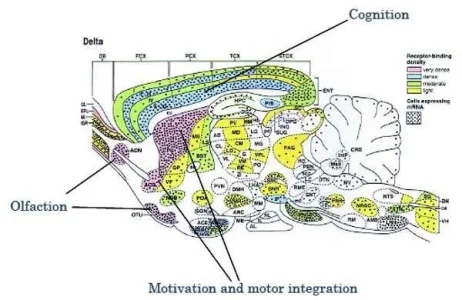
Haha! As a respectful layperson/bio student, I'd say they're at least making headway, but I think my more cynical neuroscience profs would agree with you. (In fact, what you said sounds almost like a direct quote from my psychopharmacology prof.) What we do know about the brain is nothing in comparison to what we don't know. That said... just to be evil, I've attached a slide of the localization and density of the delta opioid receptor in the brain. The diagram is very simplified. We're looking at one subtype of receptor. And then look at Wikipedia's summary table on 5-HT (serotonin) receptors and the effects of serotonin binding:
http://en.wikipedia.org/wiki/5-HT_receptor. You can see why this isn't cut-and-dried.
bright_morning said:
As a teen I escaped into the rave scene of the late 80's and early 90's and found many of my first acquaintances with feeling "safe" or "happy." All that I can say to you would be what you already seem to know, which is that those experiences can be synthesized but they hold no water until we move on to find them in very real connection with other people.
Well said, and I'm genuinely happy it worked out for you. Apart from context, it looks like the second essential element for making this work is to make the transition to a new lifestyle. (Right now, drug augmentation of fear extinction loses its effect over time, so I'd imagine having something positive to transition to, like religion or new relationships, would be very beneficial.)