
- Admin
- #1

anthony
Founder
Definitions
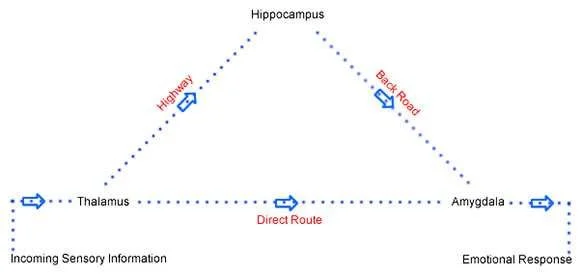
From my rough and quick image above, our information comes into the thalamus and is sent by quick and dirty transit to the amygdala, whilst simultaneously being sent to the hippocampus by highway (fast), and from the hippocampus to the amygdala by back roads (slow). From testing performed on animals, it is speculated that the path from thalamus to amygdala is shorter than that of the thalamus to hippocampus and hippocampus to amygdala.
So what does that mean? Basically, when we receive information into our brain, the amygdala is not what we want to process the information solely, as the amygdala is the fast and furious portion of our brain, possibly containing some of the most severe trauma images held by a sufferer of PTSD. If the image was intense enough it would burn directly into the amygdala, instead of being processed and stored correctly in the hippocampus initially.
What we actually want, is the information processed and response from the thalamus to hippocampus, and then back to the amygdala and output. This process gives us the complete scope of information and senses we have just been given, thus fully interpreted.
This is a more detailed analysis I guess, to simply say: with PTSD, give yourself 5 seconds before you respond, as often your immediate response is going to come from the emotional computer and alarm system – which isn’t going to be an accurate response to what you fully feel, because those parts of your response are still coming down the back road from the hippocampus.
- Amygdala – The brain’s emotional computer and alarm system
- Hippocampus – Brain’s storage for our most recent conscious memories
- Thalamus – Translates sights, sounds, smells into the language of the brain
From my rough and quick image above, our information comes into the thalamus and is sent by quick and dirty transit to the amygdala, whilst simultaneously being sent to the hippocampus by highway (fast), and from the hippocampus to the amygdala by back roads (slow). From testing performed on animals, it is speculated that the path from thalamus to amygdala is shorter than that of the thalamus to hippocampus and hippocampus to amygdala.
So what does that mean? Basically, when we receive information into our brain, the amygdala is not what we want to process the information solely, as the amygdala is the fast and furious portion of our brain, possibly containing some of the most severe trauma images held by a sufferer of PTSD. If the image was intense enough it would burn directly into the amygdala, instead of being processed and stored correctly in the hippocampus initially.
What we actually want, is the information processed and response from the thalamus to hippocampus, and then back to the amygdala and output. This process gives us the complete scope of information and senses we have just been given, thus fully interpreted.
This is a more detailed analysis I guess, to simply say: with PTSD, give yourself 5 seconds before you respond, as often your immediate response is going to come from the emotional computer and alarm system – which isn’t going to be an accurate response to what you fully feel, because those parts of your response are still coming down the back road from the hippocampus.


