• We are a multilingual website again. Read the notice about this.
  • Understand AI use at MyPTSD: all AI use is explained in our AI help page. AI use is by choice here. It exists if you want it, but does nothing unless you choose to use it.

Dissociative Experiences Scale

Status
Not open for further replies.
I got 73. I've taken this many times. I've gotten anywhere from mid 60's to upper 70's depending on when I've taken it. I also have fragments. I call them Aspects. They can influence me greatly and sometimes take over but I'm aware so it can't be DID, perhaps DDNOS/OSDD without much amnesia. I also have severe somatic dissociation.
 
I haven't taken the test since I started trauma recovery in 2011. It would be interesting to take again but my old scores were consistently around 58.
 
I wanted to mention I took the DES II on my own. It is considered a screening inventory, NOT a diagnostic tool. None of the four psychologists who have treated me put much stock in the test.

From the scoring page:
"Generally speaking, the higher the DES score, the more likely it is that the person has DID. In a sample of 1,051 clinical subjects, however, only 17% of those scoring above 30 on the DES actually had DID.

The DES is not a diagnostic instrument. It is a screening instrument. High scores on the DES do not prove that a person has a dissociative disorder; they only suggest that clinical assessment for dissociation is warranted. People experiencing DID do sometimes have low scores, so a low score does not rule out DID. In fact, given that in most studies the average DES score for a DID person is in the 40s, with a standard deviation of about 20, roughly 15% of clinically diagnosed DID patients score below 20 on the DES.

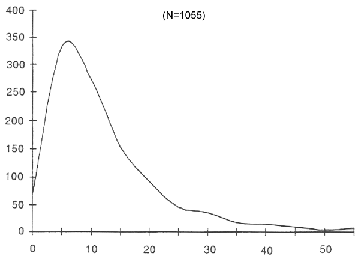
The figure shown below plots DES scores (horizontal scale) versus the number of subjects (vertical scale) from a sample of 1055 people. For further information about the DES, its validity and scoring, please visit the Ross Institute.


des-distribution.gif


(From TraumaDissociation.com)
Clinical Uses of the Dissociative Experiences Scale:

Average DES Scores in research
General Adult Population 5.4
Anxiety Disorders 7.0
Affective Disorders 9.35
Eating Disorders 15.8
Late Adolescence 16.6
]Schizophrenia 15.4
Borderline Personality Disorder 19.2
Posttraumatic Stress Disorder 31
Dissociative Disorder Not Otherwise Specified 36
Dissociative Identity Disorder (MPD) 48
 
Last edited:
I got a 73. Kinda surprised, kinda not surprised. I know I dissociate a lot. Right now actually, trying to fight it so I can keep functioning somewhat. Luckily more often than not I'm at least somewhat aware that it's happening, which is quite a benefit as otherwise my kids wouldn't be safe with me. I think that's the worst part of it all, worrying about them. But they're fantastic about it thankfully. I'll tell my 5 year old what's going on, put on TV, get snacks for them, and occasionally just have them go to their room for the duration. They know if they need something calling Mommy doesn't always work and to come and physically touch me and not to be scared if I am when it happens.

I did see a psychiatrist a few months ago who doesn't think I have DID. I'll happily go with that as I already have enough issues with PTSD, anxiety, depression, and physical health problems. It can be such a mess day to day.
 
Status
Not open for further replies.

Donation drives

2026 Donation Goal

Goal
$1,800.00
Earned
$910.00
This donation drive ends in
0 hours, 0 minutes, 0 seconds
  50.6%

Trending content

Featured content

Back
Top Bottom